Table of contents
- The Historical and Philosophical Roots of “Human Rights”
- Deconstructing the Term “Human”
- The Three Pillars of Human Rights & Their Dark Implications
- Core Differences: Haqooq-ul-Ibad vs. Human Rights
- A Practical Test Case: The LGBT Agenda
- The Paramount Importance of Haqooq-ul-Ibad in Islam
- Glaring Flaws in the UN’s Universal Declaration of Human Rights
- Final Word: An Irreconcilable Difference
In an era where the term “Human Rights” dominates global discourse, a critical confusion has emerged within Muslim communities. Often, this Western concept is mistakenly translated simply as “human rights” or even equated with the Islamic principle of Haqooq-ul-Ibad (Rights of Creation). This is not a mere linguistic oversight; it is a profound conceptual error with serious implications for Muslim faith, identity, and civilization. As conscious believers, it is imperative to dissect and understand the philosophical chasm that separates these two frameworks.
The Historical and Philosophical Roots of “Human Rights”
Human Rights is not a universal, neutral term. It is a Western construct born from a specific historical, philosophical, and anti-religious context.
- A Reaction to Church Tyranny: In medieval Europe, the Christian Papacy, in alliance with feudal monarchies, created a system of oppression. The blatant corruption and hypocrisy of religious leaders bred deep-seated resentment.
- The Rise of Humanism: This discontent sparked a rebellion against religion itself, leading to the Enlightenment. Philosophy replaced religion as the guide for life. Humanism emerged as the core philosophy, shifting the axis of the universe from God to Man. As the Encyclopedia of Philosophy states, it is a movement that places human dignity at the center, making humanity the measure of all things.
- The Core Tenet of Humanism: Its fundamental belief is, effectively, “there is no god but man.” It asserts that humans are the creators of their own reality and values. Good and evil are determined solely by human will, not by divine decree. The Quran powerfully critiques this state: “Have you seen he who has taken his own desire as his god?…” (Quran 45:23).

Read More: Haqooq-UL-Ebad
Deconstructing the Term “Human”
The word “Human” in “Human Rights” carries a loaded meaning within Western philosophy. It does not simply mean “a human being” (insan). It signifies:
- An autonomous individual, free from submission to any unseen God.
- A self-sufficient authority, where personal reason is the sole arbiter of truth and morality.
- An entity whose worth is derived from itself, not from being a creation (abd) of Allah.
The Three Pillars of Human Rights & Their Dark Implications
Under the capitalist system, Human Rights are presented as three fundamental freedoms, each with a troubling logical conclusion:
1. Freedom of Life (To Increase Capital)
This “right” mandates that life must be spent increasing capital and material growth. Anyone who does not participate in this cycle is deemed not fully “Human.” This logic was used to justify the genocide of Native Americans, who were seen as obstacles to capital growth on fertile land.
2. Freedom of Expression
Here, expression is a “right” only if it promotes the agenda of capital and liberal freedom. Critics point out that Muslims are often denied this right in the West because their core beliefs—like rejecting the divinity of Jesus (peace be upon him)—are seen as a denial of “human divinity” and thus a threat.
3. Freedom of Property
This right obligates individuals to surrender their assets to the capitalist system. Resistance leads to economic ostracization, closing the doors of livelihood.
The Ultimate Goal: The foundational aim of this framework is rebellion against the Creator. It seeks to liberate humans from the very concept of being Abdullah (a servant of God), placing unrestrained human desire and reason as the highest authority.

Read More : Rights of Workers
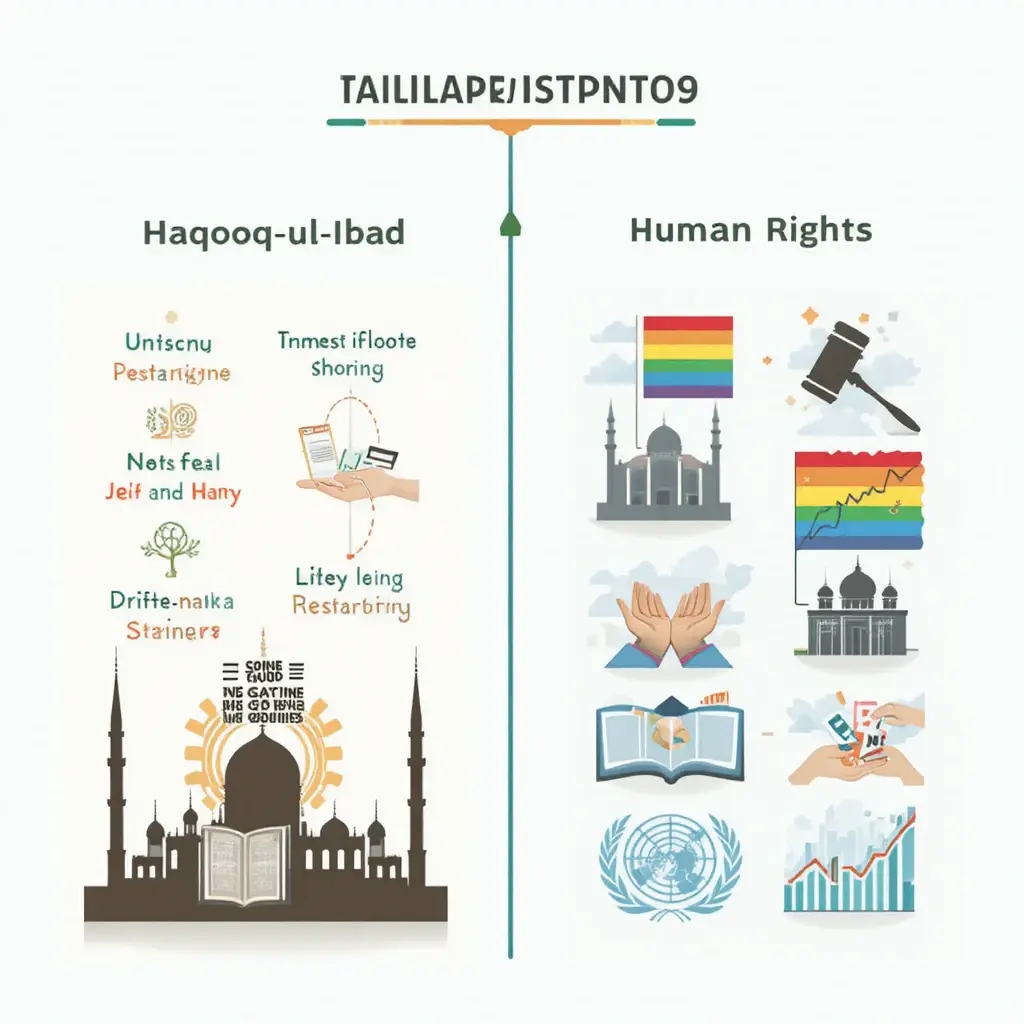
Core Differences: Haqooq-ul-Ibad vs. Human Rights
| Aspect | Human Rights (Western Framework) | Haqooq-ul-Ibad (Islamic Framework) |
|---|---|---|
| Source of Rights | Self-bestowed, inherent in being “Human.” Derives from human consensus. | Granted by Allah (God). Part of Divine Law (Shariah). A trust (amanah). |
| Worldview | Human-centric (Anthropocentric). Man is the measure. | God-centric (Theocentric). Allah is the Creator, Master, and Measure. |
| Status of Man | Sovereign, autonomous, free from divine bondage. | Abd (Servant/Creation) of Allah, dependent and accountable. |
| Core Focus | Rights (Entitlements). Emphasis on individual liberty. | Duties & Responsibilities leading to rights. Emphasis on justice, balance, and accountability. |
| Moral Compass | Determined by human reason, consensus, and changing desires. | Determined by divine revelation (Quran & Sunnah), fixed and timeless. |
| Example: Same-Sex Relations | Celebrated as a “right” under freedom of expression and life. | Prohibited as a violation of Allah’s created order and law. |
| Objective | Secular liberation, pursuit of worldly desire as an end. | Worship of Allah (Ibadah), building a just society, success in the Hereafter. |
A Practical Test Case: The LGBT Agenda
This difference is not theoretical. The United Nations actively uses Section 1 of its Human Rights charter to promote LGBT rights globally, advocating for same-sex marriage and gender fluidity. From the Islamic perspective of Haqooq-ul-Ibad, this is an explicit rebellion against the Fitrah (natural disposition) ordained by Allah. It highlights how Human Rights can become a vehicle for imposing values directly opposed to divine law.
The Paramount Importance of Haqooq-ul-Ibad in Islam
While the West codified its rights in the 17th century, Islam established a comprehensive system of mutual responsibilities over 1400 years ago. This system covers every social relationship:
- Rights of Parents (Birr al-Walidayn)
- Rights of Spouses, Children, and Relatives (Silat ar-Rahim)
- Rights of Neighbors, Orphans, the Poor, and Travelers
- Rights of Employees (Prophet Muhammad ﷺ said: “Pay the worker his wages before his sweat dries.” – Ibn Majah)
- Rights of Non-Muslim Citizens (Ahl al-Dhimmah)
Neglecting these rights is a grave sin. The Prophet ﷺ warned that on the Day of Judgment, Allah Himself will be the opponent of one who hires a worker, takes full work from him, but does not pay his wages.
Glaring Flaws in the UN’s Universal Declaration of Human Rights
1. The Deception of Absolute Equality (Article 16)
It promotes marriage equality without religious restriction, implicitly endorsing interfaith marriages that Islamic law forbids for Muslim women and normalizing unions Islam considers invalid.
2. The Destruction of the Family
While preaching gender equality, it has contributed to the breakdown of the Western family, overburdening women and stripping the household of its sanctity and stability—a model now marketed to Muslim societies.
3. Hollow Rights for Workers (Article 23)
It proclaims the right to just remuneration, yet capitalist systems worldwide exploit labor. The symbolic “Labor Day” does little while wage theft, poor conditions, and exploitation persist—in stark contrast to Islam’s enforceable and divinely sanctioned labor laws.
4. Hypocrisy on Freedom of Religion & Expression (Articles 18, 19)
These articles promise freedom of thought and religion, yet are often used selectively. While allowing blasphemy against Islamic sacred symbols under “expression,” they fail to protect Muslims’ right to practice their faith freely without smear campaigns, mosque attacks, or the desecration of the Quran—as seen in Sweden and Denmark in 2023.
Final Word: An Irreconcilable Difference
The “Universal Declaration of Human Rights” is a document of secular humanism. It is rooted in the rejection of divine sovereignty and seeks to deify human desire. Haqooq-ul-Ibad, on the other hand, is rooted in the acknowledgment of divine sovereignty and seeks to cultivate righteous servants of God.
For Muslims, conflating the two is a dangerous error. Our guidance is complete. We must champion the justice, compassion, and comprehensive rights enshrined in the Quran and Sunnah, calling mankind back to the balance established by its Creator, rather than seeking validation from a flawed, man-made alternative. The task is not to reconcile Islam with Human Rights, but to articulate and live by the superior, divine paradigm of Haqooq-ul-Ibad.