
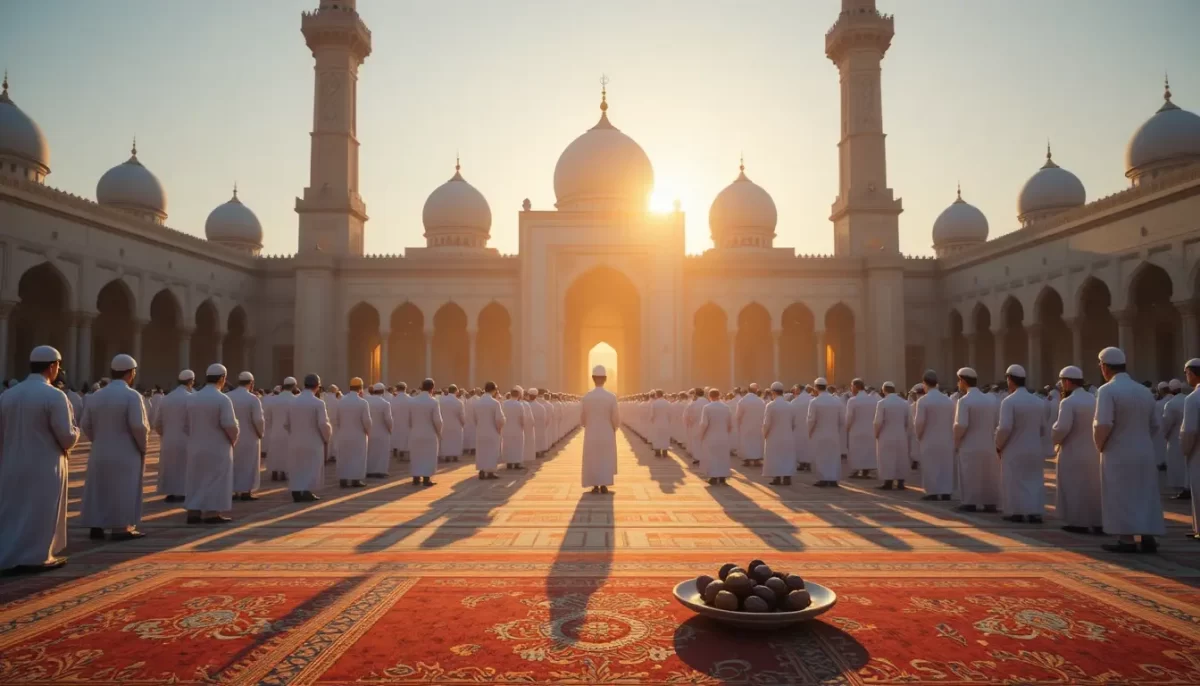
Table of contents
- Introduction: A Day of Joy, Gratitude, and Spiritual Completion
- Why Eid al-Fitr Is Celebrated in Islam
- Sunnah Practices of Eid al-Fitr
- Sadaqat al-Fitr: Obligation and Purpose
- Etiquettes of Eid Prayer
- The Spirit of Eid: Joy Within Islamic Limits
- Social Etiquette: Strengthening Bonds on Eid
- What to Avoid on Eid
- A Day of Forgiveness and Divine Mercy
- Supplication (Dua)
- Frequently Asked Questions About Eid al-Fitr in Islam
Introduction: A Day of Joy, Gratitude, and Spiritual Completion
Eid al-Fitr is not just a celebration—it is the divine reward granted to believers after a month of fasting, عبادت (‘ibādah’ – worship), and spiritual discipline. After enduring the days of رمضان (Ramaḍān) with patience, prayer, Qur’an recitation, and sincere repentance, Muslims are honored with a day of happiness and gratitude.
This blessed occasion is meant to express joy while remembering Allah’s countless blessings. It is a day when hearts are purified, communities are united, and generosity reaches its peak. However, the true beauty of Eid lies in following the teachings of Islam and the noble practices of the Prophet ﷺ.
Read More: Blessings of Ramadan
Why Eid al-Fitr Is Celebrated in Islam
Eid al-Fitr marks the completion of Ramadan and serves as a day of reward for believers.
- It is a gift from Allah for those who fasted sincerely.
- It combines joy with gratitude.
- It strengthens faith, unity, and compassion.
Allah says in the Qur’an:
“Successful indeed is the one who purifies himself, remembers the name of his Lord, and prays.”
Scholars explain that purification here includes giving Sadaqat al-Fitr, remembering Allah refers to the takbīrāt, and prayer refers to the Eid prayer.
Sunnah Practices of Eid al-Fitr
1. Eating Before Eid Prayer
It is Sunnah to eat before leaving for Eid prayer, preferably an odd number of dates.
The Prophet ﷺ would not leave for Eid al-Fitr prayer until he had eaten something (Bukhari).
If dates are unavailable, any sweet food is recommended.
2. Personal Grooming and Cleanliness
On Eid day, Muslims should:
- Take a ritual bath (ghusl)
- Use miswak (tooth-stick)
- Wear clean or new clothes
- Apply fragrance (for men)
These actions reflect dignity and gratitude.
3. Going Early for Eid Prayer
- Pray Fajr in congregation
- Leave early for Eid prayer
- Walk if possible
- Recite takbīrāt on the way
4. Using Different Routes
The Prophet ﷺ would go to Eid prayer by one route and return by another (Bukhari).
This practice symbolizes spreading blessings and meeting more people.

Read More: The Obligation and Rule of Zakat
Sadaqat al-Fitr: Obligation and Purpose
What Is Sadaqat al-Fitr?
Sadaqat al-Fitr (charity of breaking the fast) is a mandatory charity given before Eid prayer.
The Messenger of Allah ﷺ made Sadaqat al-Fitr obligatory upon every Muslim—male or female, free or slave, young or old (Bukhari, Muslim).
Who Must Pay It?
It is obligatory on:
- Every Muslim who owns wealth equal to niṣāb
- Parents on behalf of their minor children
Important: Ownership of wealth for a full year is not required.
When Should It Be Paid?
The Prophet ﷺ commanded that it be given before people go out for Eid prayer.
- Best time: Before Eid prayer
- If delayed: Must still be paid immediately after
Amount of Sadaqat al-Fitr
- Approx. 2 kg of wheat or its value
- Or 4 kg of dates, raisins, etc.
Those with greater wealth should give according to higher-value items to benefit the poor more.
Purpose of Sadaqat al-Fitr
It was prescribed to purify the fasting person from idle talk and to feed the poor (Abu Dawood).
Key purposes:
- Purifies shortcomings in fasting
- Supports the needy
- Promotes social equality and compassion

Read More: The Blessings of Iʿtikāf in Islam
Etiquettes of Eid Prayer
How to Perform Eid Prayer
Eid prayer consists of two rak‘ahs with extra takbīrs.
First Rak‘ah:
- Make intention
- Say opening takbīr and fold hands
- Recite ثناء (thana)
- Say three extra takbīrs, raising hands each time
- Continue with recitation and complete the rak‘ah
Second Rak‘ah:
- Recitation first
- Then three extra takbīrs
- Go into rukū‘ on the fourth takbīr
After prayer, two sermons are delivered, which should be listened to attentively.
The Spirit of Eid: Joy Within Islamic Limits
Eid is a day of happiness—but within the boundaries of Islam.
- Celebrate with family and friends
- Maintain modesty and dignity
- Avoid un-Islamic entertainment
The Prophet ﷺ said:
“Every nation has its festival, and this is our festival.” (Bukhari)
Social Etiquette: Strengthening Bonds on Eid
1. Visiting Relatives and Neighbors
- Strengthens family ties (Ṣilat ar-Raḥim)
- Builds love and unity
2. Greeting and Embracing
- Exchange greetings like “Eid Mubarak”
- Handshakes and embraces are encouraged
“When two Muslims meet and shake hands, their sins are forgiven before they part.” (Abu Dawood)
3. Helping the Needy
- Share food and happiness
- Ensure no one is left out
What to Avoid on Eid
Despite its joy, certain actions must be avoided:
- Free mixing without modesty
- Watching inappropriate content
- Engaging in sinful entertainment
True happiness lies in obedience to Allah, not in disobedience.
A Day of Forgiveness and Divine Mercy
Eid is also a day when:
- Sins are forgiven
- Duas are accepted
- Believers are honored by Allah
It is haram (forbidden) to fast on Eid day, emphasizing that it is a day of celebration.
Supplication (Dua)
O Allah! Grant us the ability to give Sadaqat al-Fitr, celebrate Eid according to Your guidance, and perform righteous deeds abundantly. Accept our عبادات (‘ibādāt) and grant us forgiveness. Ameen.
Frequently Asked Questions About Eid al-Fitr in Islam
1. What is the importance of Eid al-Fitr in Islam?
Eid al-Fitr marks the end of Ramadan and celebrates spiritual success, forgiveness, and gratitude to Allah.
2. Is Sadaqat al-Fitr compulsory?
Yes, it is obligatory for every eligible Muslim, including dependents.
3. Can Sadaqat al-Fitr be paid after Eid prayer?
Yes, but it is considered less rewarding and should be paid immediately.
4. What should be eaten before Eid prayer?
It is Sunnah to eat an odd number of dates or something sweet.
5. Is Eid prayer obligatory?
Yes, it is considered wajib (necessary) according to many scholars.
6. Can we celebrate Eid with entertainment?
Yes, but only within halal boundaries and avoiding sinful activities.
7. Why do Muslims greet each other on Eid?
To express joy, strengthen relationships, and spread love.