
Table of contents
- The Spirit Behind Qurbani
- Meaning and Concept of Qurbani in Islam
- The Historical Origin of Sacrifice
- Purpose of Qurbani: Taqwa, Not Meat
- Qurbani as a Sunnah of Prophet Ibrahim and Prophet Muhammad ﷺ
- Virtues and Rewards of Qurbani
- Conditions of Obligatory Qurbani
- Animals Allowed for Qurbani
- Age and Health Requirements of Animals
- Etiquette of Slaughtering
- Distribution of Sacrificial Meat
- Spiritual Philosophy Behind Qurbani
- Key Lessons from Qurbani
- Frequently Asked Questions About Qurbani in Islam
- Final Reflection
The Spirit Behind Qurbani
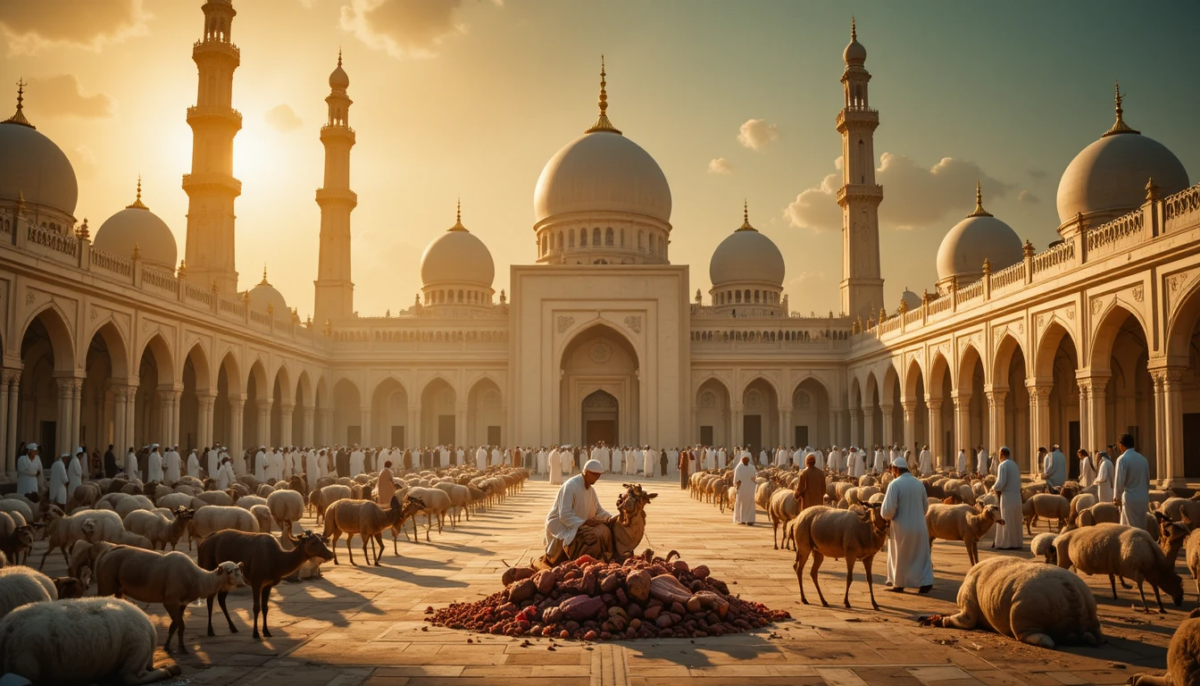
Qurbani (Islamic sacrifice) is not merely the slaughtering of an animal; it is a profound act of devotion, obedience, and submission to Allah. It reflects the believer’s willingness to prioritize divine command over personal desire. Rooted in the legacy of Prophet Ibrahim (Abraham) and his son Ismail, this sacred practice continues as a symbol of faith, gratitude, and sincerity.
Every year during Eid al-Adha, Muslims worldwide revive this tradition, remembering that Allah does not require flesh or blood—but rather sincerity, righteousness, and taqwa (God-consciousness). Qurbani is therefore an act of the heart before it is an act of the hand.

Meaning and Concept of Qurbani in Islam
The Arabic term for sacrifice, Qurbān (قربان), refers to anything through which a servant seeks closeness to Allah. In Islamic terminology, it specifically refers to the ritual sacrifice of an animal during Eid al-Adha.
Scholars such as Imam Raghib al-Isfahani explain that Qurbani means any act that brings a believer closer to Allah through devotion and obedience. Over time, it became associated with animal sacrifice performed in the blessed days of Dhul Hijjah.
The Historical Origin of Sacrifice
The concept of sacrifice dates back to the earliest human civilization. The Qur’an mentions the story of the two sons of Prophet Adam, where one sacrifice was accepted and the other rejected:
“Indeed, Allah accepts only from the righteous.” (Qur’an 5:27)
This establishes a fundamental principle: acceptance of deeds depends on sincerity and piety, not appearance.
The greatest example of sacrifice is found in the story of Prophet Ibrahim (Abraham) and his son Ismail, where both submitted to Allah’s command without hesitation. Allah replaced Ismail with a عظیم ذبیحہ (great sacrifice), establishing this practice for future generations.

Read More :The Philosophy of Sacrifice and Our Society
Purpose of Qurbani: Taqwa, Not Meat
Allah clearly states in the Qur’an:
“It is neither their meat nor their blood that reaches Allah, but it is your piety that reaches Him.” (Qur’an 22:37)
This verse highlights the true essence of Qurbani. The act is not about food distribution alone; it is about spiritual purification, obedience, and sincerity. The real goal is to develop taqwa—awareness of Allah in every action.
Qurbani as a Sunnah of Prophet Ibrahim and Prophet Muhammad ﷺ
Qurbani is a revived tradition of Prophet Ibrahim (peace be upon him), as well as the practice of Prophet Muhammad ﷺ.
The Prophet ﷺ regularly offered sacrifices, including two rams:
“The Prophet ﷺ used to sacrifice two rams, and I also sacrifice two rams.” (Reported by Anas ibn Malik)
This shows that Qurbani is deeply rooted in Prophetic practice and was consistently observed by the companions.

Read More: Huqooq ul Ibad
Virtues and Rewards of Qurbani
Islam places immense spiritual reward on Qurbani. The Prophet ﷺ said:
“For every hair of the sacrificial animal, there is a reward.” (Tirmidhi, Ibn Majah)
This means even the smallest aspect of the sacrifice is rewarded by Allah. For believers, this is a unique opportunity to accumulate countless good deeds in a single act.
Conditions of Obligatory Qurbani
Qurbani becomes obligatory on every:
- Adult Muslim (male or female)
- Resident (not a traveler)
- Owner of nisab (minimum wealth threshold)
What is Nisab?
Nisab refers to possessing wealth equivalent to:
- 87.5 grams of gold, or
- 612.36 grams of silver, or equivalent cash/property
Essential needs such as home, clothing, and tools of livelihood are excluded from calculation.
Animals Allowed for Qurbani
Islam permits only specific animals:
- Goat or sheep
- Cow or buffalo
- Camel
Shared Sacrifice
- Cow and camel allow up to 7 participants
- Each participant must intend worship, not just meat
Age and Health Requirements of Animals
Islamic law sets clear conditions:
- Camel: 5 years or older
- Cow: 2 years or older
- Goat/sheep: 1 year or older
A six-month-old lamb is acceptable only if it appears physically mature.
Animals not allowed:
The Prophet ﷺ said:
“Four types of animals are not acceptable for sacrifice…” (Abu Dawood)
These include:
- Blind animal
- Severely sick animal
- Limping animal
- Extremely weak animal
Etiquette of Slaughtering
Islam teaches compassion even during slaughter:
- Do not sharpen knife in front of the animal
- Do not slaughter one animal in front of another
- Lay animal gently facing Qiblah
- Recite Allah’s name before slaughter
A recommended supplication:
“In the name of Allah, Allah is the Greatest.”
This ensures spiritual awareness and ethical treatment.
Distribution of Sacrificial Meat
The Sunnah method of distribution is:
- One-third for the poor
- One-third for relatives and friends
- One-third for personal consumption
However, it is permissible to consume more or even all of it if needed.
Spiritual Philosophy Behind Qurbani
Qurbani teaches believers:
- Sincerity in worship
- Sacrifice for Allah’s pleasure
- Detachment from material attachment
- Gratitude for blessings
- Compassion toward the poor
It is a training of the heart, not just a ritual act.
Key Lessons from Qurbani
- Allah values intention more than appearance
- True worship requires obedience
- Sacrifice is a symbol of faith
- Wealth is a trust, not ownership
- Social responsibility is part of worship
Frequently Asked Questions About Qurbani in Islam
1. What is Qurbani in Islam?
Qurbani is the Islamic ritual sacrifice of an animal during Eid al-Adha to seek Allah’s pleasure.
2. Who must perform Qurbani?
Every adult Muslim who owns wealth above the nisab threshold must perform Qurbani.
3. Can Qurbani be performed on behalf of someone else?
Yes, it can be performed on behalf of deceased or family members with intention.
4. What animals are not allowed for Qurbani?
Blind, sick, extremely weak, or severely injured animals are not valid.
5. How is Qurbani meat distributed?
It is usually divided into three parts: family, relatives, and the poor.
6. Can a cow be shared in Qurbani?
Yes, up to seven people can share one cow or camel.
7. Is Qurbani wajib or Sunnah?
It is wajib (necessary) for eligible Muslims according to many scholars.
8. What is the main purpose of Qurbani?
The main purpose is to attain Allah’s pleasure through taqwa and obedience.
Final Reflection
Qurbani is not just a seasonal ritual—it is a lifelong lesson in submission, sacrifice, and sincerity. It connects Muslims to the legacy of Prophet Ibrahim and reminds us that true success lies in obedience to Allah.
When performed with sincerity, Qurbani becomes a source of forgiveness, spiritual elevation, and immense reward in both this world and the Hereafter.