
Table of contents
- Sign of Faith
- The Practice of Prophet Muhammad ﷺ Regarding Hospitality
- behavior of the Prophet ﷺ
- The Practice of the Companions in Hospitality
- The Reward of a Muslim’s Hospitality with Sincerity
- Hospitality is the Cause of Entry into Paradise
- The Arrival of a Guest Brings Blessings and Goodness
- A Means of Forgiveness of Sins
- Respecting and Honoring the Guest is Essential
- Emphasis on Hospitality
- Welcoming the Guest in a Good Manner
- The Duration of Hospitality is Three Days
- The Loss of Not Being Hospitable
- Respond to Evil with Good
- Some Etiquettes of Hospitality
- A few essential etiquettes for the Guest
- Conclusion:
- Prayer:
Sign of Faith
O Brothers in Islam! Hospitality is the Sunnah (tradition) of the noble Prophets and a sign of faith. Allah, the Lord of all the worlds, has mentioned the Hospitality of Prophet Ibrahim (Abraham) in the Holy Quran. The divine guidance says: ﴿وَلَقَدْ جَآءَتْ رُسُلُنَاۤ اِبْرٰهِيْمَ بِالْبُشْرٰى قَالُوْا سَلٰمًا١ؕ قَالَ سَلٰمٌ فَمَا لَبِثَ اَنْ جَآءَ بِعِجْلٍ حَنِيْذٍ﴾
“Indeed, our messengers (in the form of humans) came to Ibrahim with good news. They said, ‘Peace.’ He replied, ‘Peace,’ and soon brought a roasted calf.”
In “Tafsir al-Qurtubi” (explanation of the Quran), it is mentioned that “Prophet Ibrahim is the first on earth person who has established the tradition of hospitality in the world.”
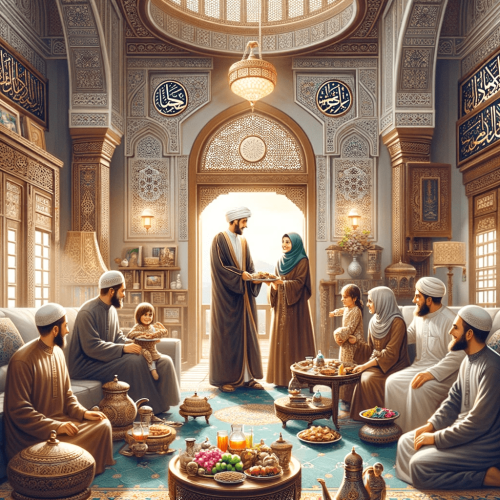
The Practice of Prophet Muhammad ﷺ Regarding Hospitality
Dear Respected ones! The practice of the Noble Prophet ﷺ concerning Hospitality is exemplary. The Master of both worlds ﷺ always took great care of his guests, always prioritizing them over himself. So much so that if he had to borrow to entertain them, he would not hesitate. Once, when a guest arrived at the Prophet’s ﷺ residence, he borrowed to provide for the Guest.
Hazrat Abu Rafi narrates that due to the arrival of a guest, the Prophet ﷺ sent me to a Jew and said, “Tell him that the Messenger of Allah ﷺ asks to borrow some flour and will repay by the crescent of Rajab.” The Jew replied that he would not lend without collateral. Upon hearing this, the Prophet ﷺ said, “By Allah, I am trustworthy in the heavens and on earth. If he had lent or sold to me, I would have repaid him! Take my armor (as collateral).”
Regarding the Hospitality of the Prophet ﷺ, it is mentioned in “Musannaf Ibn Abi Shaybah” that a villager came to the Prophet ﷺ and complained of hunger. The Prophet ﷺ went to his wives’ homes but returned saying, “I found nothing for you in the houses of the family of Muhammad ﷺ.” Just then, a roasted goat was presented. The Prophet ﷺ placed it before the villagers and said, “Eat.” Despite the prevailing poverty in the Prophet’s ﷺ household, he prioritized the Guest over his family and humbly offered the gifted roasted goat to the Guest.

Read More: Huqooq ul Ibad
behavior of the Prophet ﷺ
Considering the exemplary behavior of the Prophet ﷺ towards guests, those who prioritize themselves over their guests should reflect deeply. Despite their ability, they do not humble themselves for their excellent sake. They should not show stinginess, complain about their circumstances, or start fighting with their family So that the Guest leaves soon after seeing the poverty and tense atmosphere in the house, etc. Such behavior does not befit a Muslim, mainly when we belong to the Ummah of the Prophet ﷺ, Who did not hesitate to take a loan for the welfare and Hospitality of the Guest!
However, if there is genuine poverty in a host’s home, the Guest should refrain from prolonging their stay or asking for different kinds of food. They should eat whatever is offered and, upon departure, with a sincere intention of goodwill, give some money to the host’s children or family to assist them and maintain their dignity.
The Practice of the Companions in Hospitality
Respected audience! Following the footsteps of the Holy Prophet ﷺ, the Companions were also very hospitable. Their practice of Hospitality was such that they would not eat without a guest. They sometimes spent the entire day waiting for a guest without eating or drinking. Allah Almighty has mentioned the Hospitality of the Companions in the Holy Quran, where He says: “There is no blame upon you whether you eat together or separately.”
The esteemed Allama Sayyid Naeemuddin Muradabadi writes under this blessed verse, “The people of the tribe Bani Laith bin Amro would not eat without a guest. Sometimes, they would sit without eating from morning till evening if they didn’t find a guest. This blessed verse was revealed in their favor.” The verse above clearly indicates that the Companions were very hospitable.

Read More: Rights of Relatives
The Reward of a Muslim’s Hospitality with Sincerity
Honorable audience! Hosting a Muslim with sincerity means earning a reward and entering Paradise. Allah Almighty says: “And they give food, despite their love for it, to the needy, the orphan, and the captive, saying: ‘We feed you only for the sake of Allah. We do not want any reward or thanks from you. Indeed, we fear from our Lord a day that is austere and distressful.’ So, Allah will protect them from the evil of that day and grant them radiance and happiness and reward them with Paradise and silk for their patience.”
Hospitality is the Cause of Entry into Paradise
Dear audience! Hospitality is a means of entering Paradise. It is narrated from Hazrat Ibn Abbas that the Holy Prophet ﷺ said: “Whoever establishes prayer, gives zakat, performs Hajj, fasts in Ramadan, and hosts guests, will enter Paradise.”
It is narrated from Hazrat Anas bin Malik that the Holy Prophet ﷺ said: “Whoever hosts a believer or fulfills any of his needs, it is the responsibility of Allah Almighty to grant him servants in Paradise.”
The Arrival of a Guest Brings Blessings and Goodness
Dear brother! The arrival of a guest is a source of Mercy and blessings. It is narrated from Hazrat Anas bin Malik that the Master of the Universe ﷺ said: “Goodness comes to a house where a guest stays faster than a knife cuts through the hump of a camel.” This means that blessings and goodness arrive with great speed when there is a guest.
Hakeem-ul-Ummat Mufti Ahmad Yar Khan Naeemi explains this Hadith by saying, “There is no bone in the hump of a camel, only fat, which is easily cut by a knife, reaching its base quickly. Hence, the analogy is that blessings reach such a house very quickly.”

Read More: Rights of Workers
A Means of Forgiveness of Sins
My respected brothers! Some people express great displeasure at the arrival of guests in their homes and consider them a burden. Such an attitude is incorrect because a guest is not a burden but a mercy from Allah. Moreover, the Guest brings his sustenance with him. As narrated by Hazrat Abu Zar Ghifari, the Mercy to the Worlds ﷺ said: “When a guest comes to someone’s house, he brings his sustenance with him. And when he leaves, Allah forgives the sins of the host.” Therefore, express happiness at the arrival of guests in your home; do not consider them a burden or inconvenience, but recognize them as a means to forgive your sins!
Respecting and Honoring the Guest is Essential
Respected audience! It is essential to respect and honor the Guest. Therefore, one should not show any lack of humility for the sake of the Guest. One should fear Allah in this matter and should not do or say anything that might cause discomfort to the Guest. Allah Almighty says: “Lot said: ‘These are my guests, so do not disgrace me. Fear Allah and do not shame me.'”
From this blessed verse, it is also understood that the honor of the host lies in the respect and honor of the Guest, and the humiliation of the guest results in the humiliation of the host.
Emphasis on Hospitality
O companions of the Islamic nation! Great emphasis has been placed on Hospitality in the blessed Hadiths. It is narrated from Hazrat Abu Huraira that the Master of both worlds ﷺ said: “Whoever believes in Allah and the Last Day should honor his guest.”
Hakeem-ul-Ummat Mufti Ahmad Yar Khan Naeemi, commenting on this Hadith, says, “Honoring a guest means greeting him with a smile, arranging food and other services for him, and serving him with one’s own hands if possible. Some people lay the tablecloth for the Guest and wash his hands; this is acting upon this Hadith. Some people cook the best food they can afford for the Guests, which is also a form of humility for the Guests.
However, the Hadith does not mean that one who does not serve the Guest is an infidel. It means that serving the Guest is a requirement of faith. For example, a father might say to his son, ‘If you are my son, serve me.’ Serving the Guest is a sign of a believer. Note that on the first day, make an effort in the meal for the Guest, then serve a moderate meal for the next two days. There is also a three-day hospitality, after which it is charity.”
Welcoming the Guest in a Good Manner
Dear brother! Welcoming the Guest warmly and with a good heart is also part of Hospitality. It is narrated from Hazrat Aisha Siddiqa that the Most Merciful ﷺ said: “Treat people according to their status.” Meaning, honor, and entertain them according to their rank and status.
The Duration of Hospitality is Three Days
Respected audience! The maximum duration for Hospitality is three days. It is narrated from Hazrat Abu Shuraih Ka’bi that the Most Merciful ﷺ said: “Whoever believes in Allah and the Last Day should honor his Guest. His right is for a day and a night (Means That he welcomes the Guest well and prepares good food for him), and Hospitality is for three days (Means That is, on the second and third day, he should serve medium food). Anything beyond that is charity. It is not permissible to stay with him so long (Means more than three days) that he puts him in difficulty.”
It is narrated from Hazrat Abu Huraira that the Prophet ﷺ said: “Hospitality is for three days, and anything more than that is charity.”
Therefore, a guest should only stay at someone’s house for up to three days. The host is facing financial difficulties, and he may not have the means to entertain the Guest, or it might be inconvenient for his work. In “Sahih Muslim,” it is narrated from Hazrat Abu Shuraih Khuza’i that the Prophet ﷺ said: “It is not permissible for a Muslim man to stay with his brother (as a guest) in such a way that he makes him sinful.” The companions asked, “O Messenger of Allah ﷺ! How will he make him sinful?” The Prophet ﷺ replied: “By staying with him when he has nothing to offer him.” Yes, if the host himself asks to stay with pure heart and love, and his financial situation is also stable, then there is no problem in staying for more than three days.
The Loss of Not Being Hospitable
Dear ones! One who does not practice Hospitality misses out on blessings. It is narrated from Hazrat Uqbah bin Amir that the Prophet ﷺ said: “There is no goodness in one who does not entertain guests.”
Respond to Evil with Good
Respected ones! If someone, as a host, has shown negligence in our Hospitality, it does not mean that we should reciprocate in the same manner. As Muslims, we should respond to evil with good and entertain him well. Hazrat Sayyidna Awf bin Malik bin Nadlah Juhmi narrates from his father that he asked in the court of the Prophet ﷺ: “O Messenger of Allah ﷺ! I went to someone’s house, but he did not show me respect or Hospitality. If he comes to my house, should I honor and entertain him, or should I reciprocate his behavior?” The Prophet ﷺ replied: “No, entertain him.” This means showing him Hospitality and honoring him.
Hakeem-ul-Ummat Mufti Ahmad Yar Khan Naeemi, commenting on this Hadith, says, “If he has been rude to you, do not be rude to him. Respond to bad with good, and give him his due as a guest. Allah Almighty says: ‘Repel [evil] by that [deed] which is better.’
Some Etiquettes of Hospitality
For the Host: Respected audience! There are numerous etiquettes of Hospitality for the host. Some of them are as follows:
- The host should invite virtuous and pious people as guests.
- Honor the Guest fully, consider them a mercy from Allah, and express happiness upon their arrival.
- Don’t invite more than just politicians, business people, or the wealthy on occasions like weddings or other celebrations. Include people with low incomes in your celebrations and make them your guests.
- From time to time, invite your dear relatives and friends as guests So that there is an increase in mutual love and the order of Mercy is also followed.
- Welcome the Guest with a cheerful and enthusiastic demeanor.
- Excellent and tasty food should be served to him as soon as possible after the Guest’s arrival.
- While the Guest is eating, the host should not stop eating with his hand So that the Guest can eat to his full stomach; otherwise, the Guest may feel awkward and starve.
- Give the visitors time as much as possible, pay close attention to what they have to say, and refrain from getting impatient or irritated with them.
- Avoid making the visitor feel uncomfortable or upset by not acting or saying anything that might.
- If the Guest intends to stay, proper arrangements should be made, and a clean bed should be laid for him.
- Accompany the Guest to the door as they leave and express regret for any inadequacies in Hospitality.
A few essential etiquettes for the Guest
For the Guest: Dear brothers! Just as the host needs to follow the etiquette of Hospitality, the Guest should also keep in mind the following when visiting someone’s home:
- A guest should only visit someone’s home with prior notice because it is possible that the owner of the house is not at home or is busy with some important work, which makes him unable to give time to the Guest.
- Don’t demand specific foods; accept whatever is offered. However, if a close relationship with the host and requesting a particular dish would bring them joy, then it’s acceptable.
- Do not find fault in the host’s house, food bed, etc., but if he is happy with the Hospitality, he should be full of praise; appreciating a guest brings joy and happiness to the host.
- Do not stay in someone’s house as a guest for more than three days; that will cause them trouble.
- When one starts to leave one’s house, one should pray well for blessings in life, property, honor, honor, sustenance, and children, etc., of the family;
- it is Sunnah to make supplication for the one who gives food and Hospitality. Hazrat Miqdaad bin Aswad says That Rasul e Akram ﷺ said: “O Allah! He who fed me, you fed him, and he who gave me water, you gave him water.” That is, bless their sustenance!
Conclusion:
Dear friends, brothers, and elders! Islam places great importance on Hospitality. Unfortunately, in this materialistic age, we Muslims are drifting away from this noble quality. Despite having the means, we hesitate to host our relatives and friends, especially people with low incomes, orphans, and needy. We see it as a financial burden rather than a blessing. Such an attitude is contrary to Islamic teachings and the dignity of a Muslim.
Prayer:
Oh Allah, please help us appreciate the value of Hospitality. Give us the pleasure of looking after our visitors. Keep us from considering visitors to be a burden. O Allah, accept our prayers, purify our souls, and enable us to follow the Sunnah and the teachings of the Quran via the intercession of Your beloved Prophet ( ). O Allah, make us faithful and committed followers of Your Prophet, uphold our bond, and direct us to carry out our religious obligations sincerely. Give us all the good in this world and the next, and shield us from all bad. Bless our means of subsistence, guard our honor, and set our persecuted Muslim brothers and sisters in Kashmir and Palestine free. Praise be to Allah, the Lord of all worlds. May Allah’s blessings be upon our beloved Prophet Muhammad ﷺ, his family, and his companions. Amen!